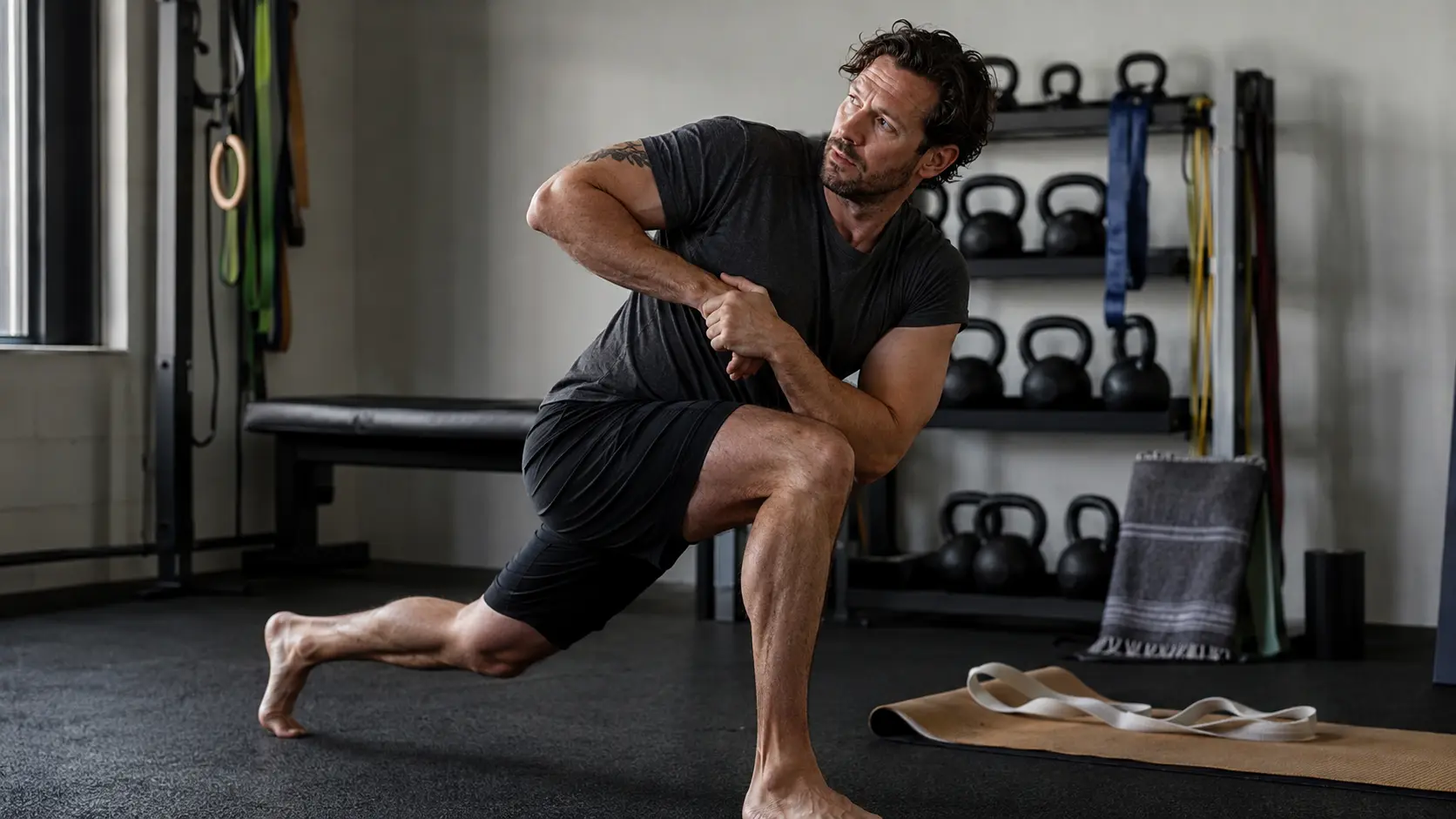
You feel stiff after sitting all day, your shoulders ache when you lift your arms overhead, and you can’t touch your toes without pain, yet you have no idea if the problem is mobility versus flexibility or what to actually do about it.
What is mobility?
Mobility is your joint’s ability to move through its full range of motion while maintaining control and stability. Think of it as active movement with strength behind it. When you squat down to pick something up, rotate your shoulder to reach behind you, or twist your spine to look over your shoulder, you’re using mobility. It’s not just about how far you can stretch; it’s about moving that distance with purpose and power. For young adults, mobility becomes critical because poor mobility often leads to compensation patterns. Your body adapts to limited movement by using other muscles or joints in ways they weren’t designed for, which creates imbalance and injury risk. A tight hip, for example, might force your lower back to compensate during a deadlift, leading to strain. Good mobility prevents this domino effect and keeps your movement patterns clean and efficient.
- Improves posture and reduces the risk of injury
- Enhances athletic performance
- Facilitates better overall movement patterns
What is flexibility?
Flexibility is purely about muscle length and how much your muscles can stretch without resistance. It’s a passive quality, meaning your muscles can elongate whether or not you have the strength to control that range. You can be flexible and still lack mobility if your muscles are long but weak in those extended positions. Imagine touching your toes easily but struggling to hold a deep squat with proper form. That’s high flexibility but potentially lower mobility. For young adults, flexibility matters because tight muscles limit your comfort in daily life and can contribute to postural issues. Chronically tight hamstrings pull on your pelvis, tight hip flexors tilt your spine forward, and tight chest muscles round your shoulders. However, flexibility alone won’t fix movement quality. You need the strength and control that mobility provides to actually use that range of motion safely and functionally.
📘 Fix your day in under 2 minuteschoose where to begin:
How to improve mobility
Start by identifying which joints feel restricted. Common problem areas for young adults include hips, shoulders, thoracic spine, and ankles. Once you know where you’re limited, use dynamic stretches and mobility drills that move the joint through its range while you’re actively working. Cat-cow stretches for your spine, arm circles for shoulders, and leg swings for hips all qualify. Add strength training into restricted ranges; this teaches your body to control movement in those positions. A simple example: if your shoulder mobility is poor, practice push-ups with a reduced range of motion, then gradually increase depth as control improves. Spend 10 to 15 minutes daily on mobility work targeting your weak points. Consistency matters far more than intensity. Many young adults make the mistake of pushing too hard too fast, which triggers protective muscle tension instead of improvement. Move slowly, breathe deeply, and respect your body’s signals. Within 3 to 4 weeks of consistent work, you’ll notice real changes in how you move and feel.
How to improve flexibility
Static stretching is your primary tool here. Unlike dynamic stretches, static stretches involve holding a position for 20 to 60 seconds while relaxed. Target major muscle groups: hamstrings, hip flexors, quadriceps, chest, shoulders, and calves. The key is consistency and patience. Stretching 3 to 5 times per week yields better results than occasional intense sessions. Yoga and Pilates naturally build flexibility because they combine stretching with controlled movement and breathing. If you’re new to stretching, expect it to feel uncomfortable at first. That discomfort is normal; your nervous system is learning to allow lengthening. However, sharp or shooting pain is a red flag and means you’ve gone too far. A common mistake young adults make is bouncing during stretches or pushing into pain. This triggers the stretch reflex, which actually tightens muscles as a protective response. Instead, ease into a comfortable stretch and breathe. Perform stretching after workouts or in the evening when muscles are warm and more pliable. Over 6 to 8 weeks, you’ll gain noticeable flexibility gains.
Balancing mobility and flexibility
The ideal approach combines both qualities into a cohesive routine. Dedicate 2 to 3 days per week to mobility work focusing on control and strength through range, and 3 to 5 days per week to flexibility work emphasizing muscle length and relaxation. A practical weekly structure might look like this: Monday and Thursday for dedicated mobility sessions using dynamic stretches and loaded movements; Tuesday, Wednesday, and Saturday for flexibility work with static stretches or yoga; and Friday for a full-body strength session that naturally challenges mobility. This balanced approach prevents the pitfall of being flexible but weak or mobile but tight. Young adults who only stretch often remain stiff because they lack strength in those ranges. Conversely, those who only strength train often become increasingly restricted. The sweet spot is having muscles that are both long enough to move freely and strong enough to control that movement. Track your progress by noting how daily activities feel. Can you squat deeper? Does your back hurt less? Do you feel more fluid when you move? These real-world improvements matter more than any single metric.
Mobility and flexibility serve different but complementary roles in movement quality. Mobility gives you control through a full range of motion, while flexibility ensures muscles can lengthen without strain. Young adults benefit most from a balanced routine that includes dynamic stretches and strength training for mobility, combined with static stretching and yoga for flexibility. Consistency over 4 to 8 weeks produces noticeable results. Avoid the common mistakes of pushing too hard, bouncing during stretches, or neglecting one quality in favor of the other. Start with your tightest areas, progress gradually, and listen to your body’s feedback.
Can I improve my mobility and flexibility at any age?
Yes, both mobility and flexibility can be enhanced through regular practice and proper training at any age. It’s never too late to start working on improving your joint function and muscle elasticity. Young adults often see results faster because their tissues are more responsive, but older adults absolutely can improve with patience and consistency.
Are there specific exercises to target mobility and flexibility?
Yes, exercises like hip circles, shoulder rotations, and lunges can enhance mobility, while stretches like hamstring stretches, quad stretches, and spinal twists can improve flexibility in key muscle groups. For mobility, add loaded movements like goblet squats or push-ups. For flexibility, try yoga poses like downward dog or pigeon pose held for 30 to 60 seconds.
Others also read:
Disclaimer: This article is for informational purposes only and is not a substitute for professional medical advice. Always consult a healthcare professional for personal guidance.
This guide has been prepared and reviewed by the GlobalHealthBeacon editorial team and reflects current medical research as of 2026. It provides structured, evidence-based information to support informed health decisions.
