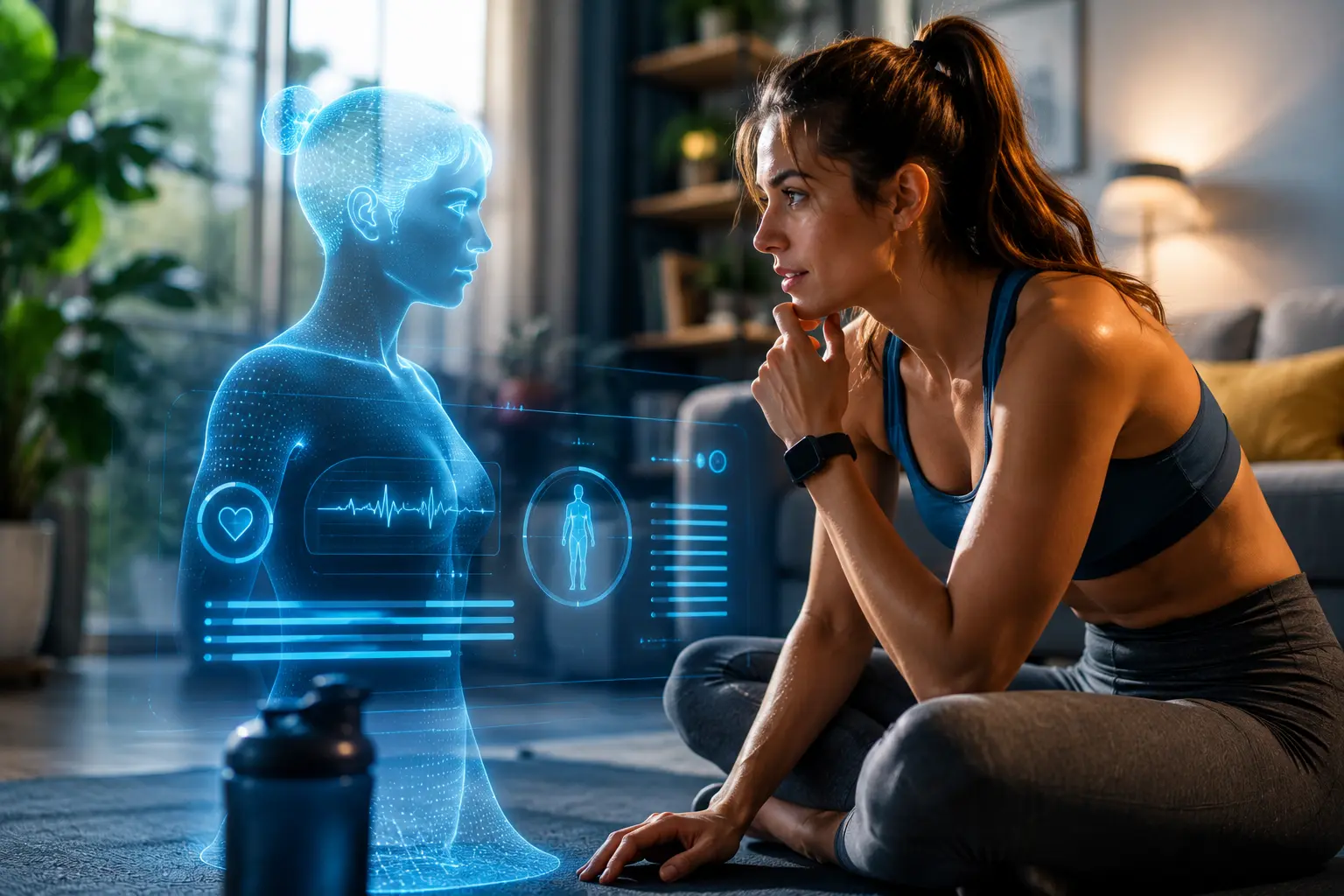
You’re juggling work, social life, and trying to stay healthy, but generic fitness advice feels like it was written for someone else entirely, and that’s because AI health coach explained is the missing piece that actually gets how your life works.
Understanding AI health coaching
AI health coaching represents a fundamental shift in how personalized wellness guidance works. Rather than following a one-size-fits-all program, these systems function as adaptive digital advisors that learn your patterns over time. Imagine having a coach who knows that you hit the gym at 6 AM on weekdays but prefer yoga on weekends, understands your food preferences and dietary restrictions, and remembers that stress from work affects your sleep quality. AI health coaches integrate data from multiple sources including fitness trackers like Fitbit or Apple Watch, nutrition apps such as MyFitnessPal, sleep monitors, and even medical records if you grant access. The system then synthesizes this information to create recommendations that actually fit your life rather than forcing you into someone else’s mold. For a young adult balancing a demanding job with social commitments, this personalization becomes invaluable because the advice adapts as your circumstances change.
How AI analyzes your data
The analytical process behind AI health coaching involves sophisticated pattern recognition that operates silently in the background. When you log your workouts, meals, and sleep hours, the AI doesn’t just store this information; it searches for hidden correlations that explain your health outcomes. For instance, the system might discover that your energy levels spike on days when you sleep seven hours and eat protein within two hours of waking, but crash when you skip breakfast despite getting adequate sleep. These insights emerge from processing thousands of data points across time, identifying what actually moves the needle for your specific biology rather than relying on general population statistics. The AI examines temporal patterns too, recognizing that your motivation for exercise peaks on Monday mornings but dips by Friday evening, or that your stress levels correlate with specific work deadlines. By connecting these dots, the system generates actionable suggestions grounded in your actual behavior rather than theoretical ideals, making recommendations feel relevant and achievable rather than preachy or disconnected from reality.
The benefits of AI health coaching
AI health coaching delivers three core advantages that distinguish it from traditional approaches. First, personalized guidance means recommendations align with your specific circumstances, preferences, and constraints rather than generic protocols. If you’re vegetarian, the system won’t suggest chicken breast; if you have a knee injury, it won’t recommend high-impact cardio. Second, continuous support operates on your schedule, not office hours. At 11 PM when you’re considering whether to order pizza or cook at home, your AI coach can remind you of your goals and suggest quick meal options you actually enjoy. Third, data-driven insights transform raw numbers into meaningful patterns. Instead of vague advice to eat healthier, you receive specific feedback like your digestion improves when you include more fiber, or your workout recovery accelerates when you prioritize sleep over late-night social media. These benefits compound over time as the system refines its understanding of what works uniquely for you, creating a feedback loop where recommendations become increasingly relevant and effective.
- Track your health data consistently using wearable devices and health apps, allowing the AI system to gather sufficient information about your patterns, preferences, and responses to different behaviors.
- Review the personalized recommendations provided by your AI health coach regularly, noting which suggestions resonate with your lifestyle and which feel unrealistic or misaligned with your goals.
- Implement the suggested changes in your daily routine gradually, starting with one or two modifications rather than overhauling everything at once, then observe how these changes affect your energy, mood, and overall health outcomes.
- Provide feedback to the system about what worked and what didn’t, helping the AI refine its understanding of your unique biology and preferences so future recommendations become increasingly accurate and actionable.
🔬 Science-backed benefits in 2 minuteschoose where to begin:
The role of machine learning in AI health coaching
Machine learning forms the engine that makes AI health coaching genuinely adaptive rather than static. Unlike traditional software that follows fixed rules, machine learning algorithms improve through exposure to your data and feedback. When you rate a recommendation as helpful or dismiss it as irrelevant, the system learns your preferences and adjusts future suggestions accordingly. This continuous refinement process means your AI coach becomes more accurate and aligned with your needs over weeks and months of interaction. Consider a practical scenario: initially, the system might suggest evening workouts based on your calendar availability, but after you consistently skip those sessions and complete morning workouts instead, the algorithm recalibrates to prioritize morning recommendations. Machine learning also identifies subtle patterns humans would miss, such as discovering that your adherence to health goals improves by 40 percent when recommendations arrive via text message rather than app notifications, or that you’re more likely to try new recipes on Sunday evenings. This learning capacity transforms the coaching experience from prescriptive to genuinely responsive, creating a partnership where the system evolves alongside your changing circumstances, preferences, and life stage.
Future trends in AI health coaching
The landscape of AI health coaching continues evolving with emerging technologies that promise richer, more immersive experiences. Virtual reality and augmented reality integration could enable guided workouts in simulated environments, making exercise feel less like a solo effort and more like training with a coach or community. Natural language processing advancements will enable more conversational interactions, allowing you to ask your AI coach questions in plain English rather than navigating menus and buttons. Imagine discussing your stress levels and receiving tailored suggestions through dialogue that feels genuinely human. Integration with wearable technology will deepen as sensors become more sophisticated, potentially monitoring biomarkers like heart rate variability, cortisol levels, and inflammatory markers in real time. Predictive analytics represent another frontier, where AI might forecast health challenges before they manifest, alerting you to adjust your routine before burnout or illness develops. Federated learning and privacy-preserving technologies will likely improve, allowing AI systems to learn from population-level patterns while keeping your individual data completely private. These developments suggest AI health coaching will become increasingly personalized, accessible, and integrated into daily life rather than remaining a separate tool you consciously engage with.
Ethical considerations in AI health coaching
As AI health coaching becomes more prevalent, several critical ethical dimensions demand attention and transparency. Privacy represents the most immediate concern since health data ranks among the most sensitive personal information you possess, revealing patterns about your body, behaviors, and vulnerabilities. Understanding exactly how your data gets stored, who can access it, and whether it’s sold to third parties becomes essential before trusting any system with this information. Data security matters equally because a breach could expose intimate details about your health status, medication use, or lifestyle choices. Beyond data handling, there’s the question of algorithmic bias: if AI systems train primarily on data from certain demographic groups, recommendations might prove less effective or even harmful for others. Transparency about limitations also matters; AI health coaches should clearly communicate that they complement rather than replace medical professionals, and that serious health concerns require human clinical evaluation. The potential for over-reliance on AI recommendations without critical thinking represents another consideration, particularly for young adults who might trust algorithmic suggestions more than their own intuition or professional medical advice. Responsible development requires ongoing scrutiny of these issues and clear communication about what AI can and cannot do.
AI health coaching harnesses advanced algorithms and machine learning to deliver personalized guidance grounded in your actual data rather than generic protocols. By analyzing patterns across fitness, nutrition, sleep, and stress, these systems provide recommendations that evolve as your circumstances change, offering continuous support tailored to your unique biology and lifestyle. Understanding how this technology works, its genuine benefits, and its limitations empowers you to use it effectively as part of a broader approach to wellness that includes professional medical guidance when needed.
How does AI health coaching personalize recommendations?
AI health coaching personalizes recommendations by analyzing your individual health data including workout patterns, nutrition choices, sleep quality, and stress levels, then identifying correlations specific to your biology. The system learns from your feedback and behavior over time, continuously refining suggestions to match what actually works for you rather than applying generic population-level advice.
What are the future prospects for AI health coaching?
Future developments in AI health coaching include integration with virtual and augmented reality for immersive coaching experiences, advanced natural language processing enabling conversational interactions, deeper wearable technology integration for real-time biomarker monitoring, and predictive analytics that anticipate health challenges before they develop. Privacy-preserving technologies will also improve, allowing systems to learn from broader patterns while protecting individual data.
Others also read:
Disclaimer: This article is for informational purposes only and is not a substitute for professional medical advice. Always consult a healthcare professional for personal guidance.
This article has been prepared and reviewed by the GlobalHealthBeacon editorial team and is based on current medical research and published scientific literature available in 2026. It provides structured, evidence-based information to support informed health decisions.
