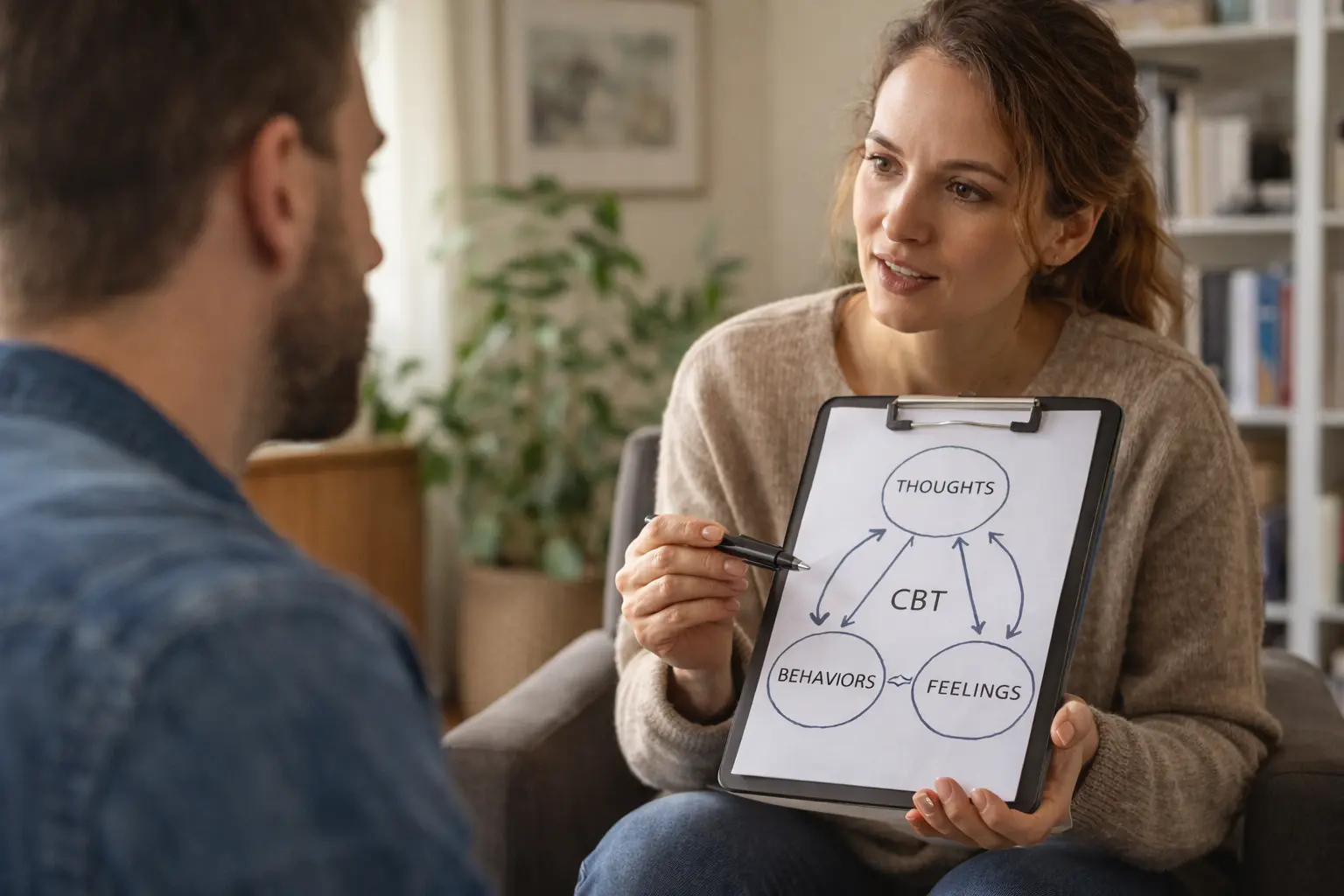
If you’re tired of feeling stuck in the same anxious loops, replaying worries that won’t quit, cognitive behavioral therapy explained might be the shift you’ve been looking for, and the science backing it up for seniors is actually pretty solid.
Understanding cognitive behavioral therapy for seniors
Cognitive behavioral therapy, or CBT, is a structured psychotherapy approach that operates on a straightforward principle: our thoughts, feelings, and behaviors are deeply interconnected. For seniors navigating the complexities of aging, this framework becomes particularly valuable. Consider Margaret, a 72-year-old who found herself avoiding social gatherings because she convinced herself she would embarrass herself or be judged. CBT helped her identify that specific thought pattern and trace how it triggered anxiety, which then led to avoidance behavior. The therapy teaches seniors to recognize these automatic negative thoughts that often feel like facts but are actually interpretations. By learning to examine and challenge these patterns, older adults can address anxiety, depression, and stress more effectively. The beauty of CBT for this age group is that it doesn’t require extensive introspection or years of therapy. It’s practical, goal-oriented, and focuses on real-world application. Many seniors appreciate that CBT gives them concrete tools rather than abstract concepts.
The science behind CBT: how it works
The mechanism of CBT rests on neuroscience and cognitive psychology. When we experience a triggering event, our brain generates automatic thoughts, which then produce emotional and physical responses. A senior might notice a small tremor in their hand and immediately think, ‘I’m losing my mind, something is seriously wrong.’ This thought cascades into anxiety, which paradoxically makes the tremor worse. CBT interrupts this cycle by teaching people to pause and examine the evidence for and against their automatic thought. Is there actually evidence of serious illness, or could the tremor be caffeine, stress, or simple aging? Through this process, called cognitive restructuring, seniors develop more balanced, realistic thoughts. Brain imaging studies show that repeated CBT practice actually changes neural pathways, strengthening connections in areas responsible for emotional regulation and rational thinking. Over time, the brain becomes more efficient at catching distorted thoughts before they spiral. This isn’t positive thinking or ignoring problems. It’s about seeing situations more accurately and responding based on facts rather than fear.
Research on CBT efficacy in seniors
Decades of clinical research consistently demonstrate CBT’s effectiveness for older adults. Studies published in journals like the American Journal of Geriatric Psychiatry show that seniors receiving CBT experience significant reductions in depressive symptoms, often comparable to medication outcomes but without pharmaceutical side effects. One landmark study followed 200 seniors with late-life depression over 16 weeks. Those receiving CBT showed a 50 percent reduction in symptoms, with benefits maintained at one-year follow-up. Research also indicates CBT helps with anxiety disorders, insomnia, and even cognitive concerns. What’s particularly encouraging is that seniors respond well to CBT regardless of age, with 75-year-olds showing similar improvement rates as 60-year-olds. The research also reveals that CBT works synergistically with other treatments. Seniors taking antidepressants who also engage in CBT often see better outcomes than medication alone. Additionally, studies show that skills learned in CBT remain effective long after therapy ends, suggesting lasting neurological change rather than temporary symptom suppression.
- Consult with a qualified mental health professional, such as a therapist or psychologist, to assess whether CBT aligns with your specific concerns and health situation.
- Participate actively in CBT sessions, typically 12 to 20 weekly meetings, where you will learn cognitive restructuring techniques and practice identifying thought patterns in real time.
- Complete homework assignments between sessions, such as thought records or behavioral experiments, to reinforce skills and track progress in your daily life.
🔬 Science-backed benefits in 2 minuteschoose where to begin:
Applying CBT techniques in everyday life
The real power of CBT emerges when seniors take techniques outside the therapist’s office and into their actual lives. One practical technique is the thought record, where you write down a triggering situation, the automatic thought that arose, the emotion you felt, and then examine evidence for and against that thought before developing a more balanced perspective. For example, a senior might write: Situation: My daughter didn’t call today. Automatic thought: She’s angry with me and doesn’t care anymore. Emotion: Sadness and anxiety. Evidence against: She called three days ago and said she was busy with work. She texted yesterday. We had a good visit last week. Balanced thought: She’s probably just busy. I can reach out to her if I’m concerned. Another technique is behavioral activation, where you intentionally engage in activities that bring meaning or pleasure, even when motivation is low. This directly counters the isolation and withdrawal that often accompany depression. Seniors might also use relaxation techniques like progressive muscle relaxation or breathing exercises when they notice anxiety building. The key is consistency and self-compassion. Progress isn’t linear, and practicing these skills regularly, even on good days, strengthens your mental resilience.
Potential benefits of CBT for seniors
Beyond symptom reduction, CBT offers seniors broader life improvements. Research shows that older adults who engage in CBT report enhanced social connections, partly because they’re no longer avoiding situations due to anxiety or depression. They also report improved sleep quality, better pain management, and increased cognitive sharpness. One study found that seniors using CBT showed measurable improvements in memory and processing speed, suggesting the therapy may have neuroprotective effects. Perhaps most importantly, many seniors describe a renewed sense of agency and control. Instead of feeling like victims of their circumstances or emotions, they recognize themselves as active participants in their mental health. This shift in perspective often extends beyond mental health into physical health behaviors. A senior who learns to challenge catastrophic thinking about a minor health symptom might be more likely to exercise regularly or maintain social engagement, both of which have documented health benefits. The cumulative effect is often described as a return to feeling like yourself, with more energy, clearer thinking, and a stronger sense of purpose.
Future directions in CBT research for seniors
The field of geriatric mental health is evolving rapidly. Researchers are now investigating how to deliver CBT through teletherapy platforms, which is particularly valuable for seniors with mobility limitations or those in rural areas. Early studies show that video-based CBT is equally effective as in-person sessions for many older adults. Scientists are also developing tailored CBT protocols for specific age-related challenges, such as grief after losing a long-term partner, adjustment to retirement, or managing multiple chronic health conditions. Emerging research explores how CBT can be combined with other approaches, like mindfulness-based cognitive therapy, to enhance outcomes. Some studies are examining whether brief, intensive CBT delivered in fewer sessions might work for certain seniors. Additionally, researchers are investigating how CBT can address cognitive decline and potentially slow progression in conditions like mild cognitive impairment. As the senior population grows, access to evidence-based mental health care becomes increasingly important. These innovations promise to make CBT more accessible, personalized, and effective for older adults seeking to maintain mental well-being and quality of life.
Research indicates that CBT is an effective psychotherapeutic approach for seniors, offering tools to challenge negative thought patterns and improve emotional well-being. By engaging in CBT techniques, older adults can experience enhanced mental health, social connections, and overall quality of life.
Is CBT suitable for all seniors?
CBT can be beneficial for many seniors, but individual differences and preferences should be considered. Consulting with a mental health professional can help determine the appropriateness of CBT as a treatment option.
Are there any potential side effects of CBT for seniors?
CBT is generally considered safe for seniors, with minimal risk of adverse effects. However, some individuals may experience temporary discomfort or increased emotional awareness as they engage in the therapeutic process.
Others also read:
Disclaimer: This article is for informational purposes only and is not a substitute for professional medical advice. Always consult a healthcare professional for personal guidance.
This article has been prepared and reviewed by the GlobalHealthBeacon editorial team and is based on current medical research and published scientific literature available in 2026. It provides structured, evidence-based information to support informed health decisions.
← Back to the Main page on: cognitive behavioral therapy explained

