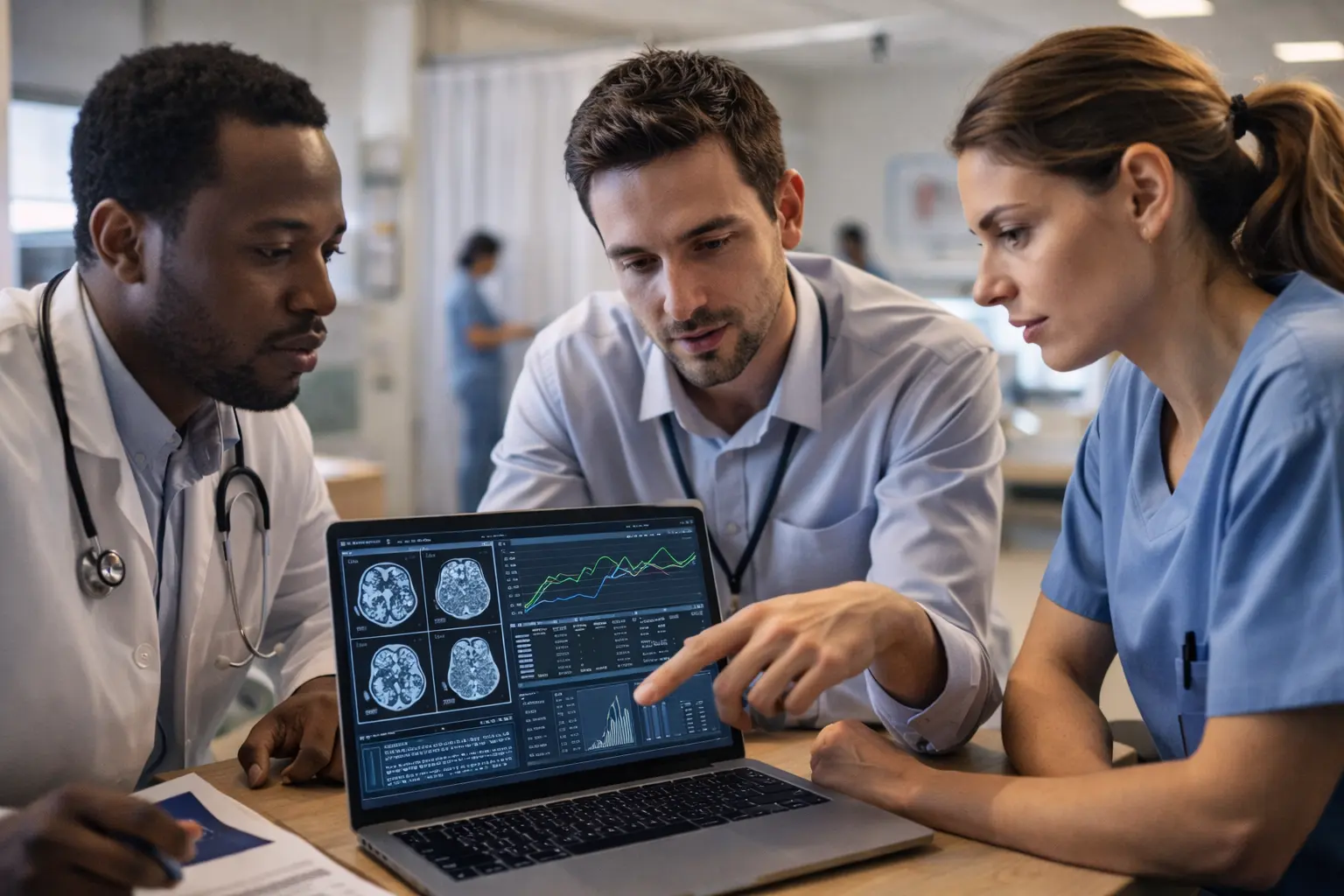
You’re watching your doctor spend half the appointment typing notes instead of actually listening to you, and meanwhile algorithms somewhere are supposedly getting smarter at predicting what’s wrong with people like you, so let’s cut through the hype and see if good machine learning practice in healthcare actually delivers on its promises or if it’s just another tech buzzword masking the same old problems.
Understanding machine learning in healthcare
Machine learning algorithms work by analyzing patterns in massive datasets without being explicitly programmed for every scenario. Think of it like this: instead of a doctor memorizing every possible symptom combination for a disease, an ML algorithm ingests thousands of patient records and learns to recognize patterns humans might miss. In healthcare specifically, these algorithms process medical imaging scans, lab results, genetic data, and patient histories to identify disease markers, predict treatment responses, and flag potential health risks before symptoms appear. For young adults, this matters because conditions like early-onset diabetes, cardiovascular disease, and certain cancers often develop silently. An algorithm trained on millions of cases can spot subtle warning signs in your bloodwork or imaging that might otherwise go unnoticed during a routine checkup. The technology doesn’t replace doctors; rather, it acts as a sophisticated second opinion that works 24/7.
Benefits of machine learning in clinical practice
The real-world benefits of machine learning in healthcare extend far beyond what sounds good in theory. Consider diagnostic accuracy: studies show that ML algorithms can detect certain cancers in medical images with accuracy rates matching or exceeding experienced radiologists, sometimes catching tumors at earlier, more treatable stages. For young adults managing chronic conditions, ML-powered systems can analyze your unique genetic profile and medication history to recommend personalized treatment plans rather than the one-size-fits-all approach. Administrative efficiency matters too, even if it sounds boring. When ML handles appointment scheduling, insurance verification, and medical record organization, your doctor spends less time on paperwork and more time actually talking to you. Predictive analytics help hospitals anticipate which patients might develop complications, allowing preventive interventions. Real example: a young adult with family history of heart disease gets flagged by an algorithm for early screening, catches a developing issue, and avoids a potential heart attack at age 35. That’s not hype; that’s measurable impact on someone’s actual life.
Implementing machine learning in healthcare
Building a functional ML system in healthcare involves multiple interconnected steps that each require careful attention. First comes data collection, which sounds simple but is deceptively complex. Healthcare facilities must gather diverse, representative data from different patient populations, ensuring the dataset includes various ages, ethnicities, and disease presentations so the algorithm doesn’t learn biased patterns. Second, model selection requires matching the right algorithm to the specific problem. A system designed to predict hospital readmission risk uses different mathematical approaches than one designed to interpret chest X-rays. Third, training the model means feeding it labeled examples where the correct answer is already known, allowing the algorithm to learn the relationship between inputs and outcomes. A practical example: if you’re building a system to predict which young adults are at risk for depression relapse, you’d train it on thousands of past patient records where outcomes are documented, then test it on new patients to verify accuracy before deployment. Throughout implementation, validation at each stage prevents garbage data from creating garbage predictions.
- Collect diverse, representative healthcare data from varied patient populations to prevent algorithmic bias.
- Select an appropriate machine learning model matched to the specific clinical prediction or diagnostic task.
- Train the algorithm using labeled historical data, then validate performance on independent test cases before clinical deployment.
🔬 Science-backed benefits in 2 minuteschoose where to begin:
Challenges and limitations of machine learning in healthcare
Machine learning in healthcare faces real obstacles that don’t get solved by simply having more computing power. Data privacy stands as the first major hurdle; your medical records contain deeply personal information, and training algorithms requires access to that data while protecting patient confidentiality. Algorithm bias represents another critical issue: if the training data comes primarily from one demographic group, the algorithm learns patterns specific to that population and performs poorly for others. A young adult from an underrepresented ethnic group might receive inaccurate risk predictions because the algorithm was trained mostly on different populations. Interpretability creates a frustrating paradox: many of the most accurate ML models function as black boxes, making predictions without explaining why, which creates problems when doctors need to justify treatment decisions to patients or justify them in court. Additionally, healthcare data is messy and incomplete. Patient records contain typos, missing values, and inconsistent terminology that can corrupt algorithmic learning. Common mistake: deploying an algorithm without continuous monitoring, allowing it to drift from accuracy as patient populations change or new disease variants emerge.
Future of machine learning in young adult healthcare
The trajectory of machine learning in healthcare points toward increasingly personalized and predictive medicine tailored to individual biology. Predictive analytics will likely shift healthcare from reactive treatment to proactive prevention, identifying which young adults will develop specific conditions years before symptoms appear. Precision medicine powered by ML will analyze your genetic makeup, lifestyle data, and family history to recommend treatments designed specifically for your biological profile rather than population averages. Remote patient monitoring through wearable devices and home sensors will feed continuous health data into algorithms that detect subtle changes indicating developing problems. Imagine a scenario where your smartwatch data combined with periodic lab work automatically alerts your doctor to early signs of thyroid dysfunction before you feel tired or gain weight. Integration of multiple data streams, from genetic testing to mental health apps to fitness trackers, will create comprehensive health pictures that current fragmented systems cannot provide. These advances require solving current challenges around privacy, bias, and interpretability, but the potential to catch disease early and personalize treatment represents genuine progress for young adult health outcomes.
Ethical considerations in machine learning practice
Deploying machine learning in healthcare demands rigorous ethical frameworks because algorithms make decisions that directly affect human lives and health outcomes. Transparency means patients should understand when algorithms influence their care and how those algorithms work, not just accept recommendations as mysterious computer pronouncements. Accountability requires clear responsibility chains: if an algorithm makes a harmful error, who bears responsibility and how is the patient compensated? Patient consent becomes complicated because most people don’t understand ML well enough to meaningfully consent to its use in their care. Regulatory frameworks like HIPAA protect data privacy, but they’re constantly playing catch-up with technology. A critical principle: algorithms should enhance human judgment, not replace it. Your doctor should always be the final decision-maker, with the algorithm serving as a sophisticated tool providing additional information. Common mistake: treating algorithmic predictions as certainties rather than probabilities. An algorithm might say you have a 75 percent risk of developing a condition, but that’s not a diagnosis; it’s a signal for further investigation. Responsible implementation requires ongoing auditing for bias, regular retraining as populations change, and genuine transparency about limitations.
Machine learning in healthcare offers measurable potential for improving clinical outcomes through data-driven decision-making and pattern recognition beyond human capacity. For young adults, good machine learning practice in healthcare can enable earlier disease detection, personalized treatment recommendations, and preventive interventions that catch problems before they become serious. However, realizing this potential requires addressing real challenges around data privacy, algorithmic bias, interpretability, and ethical deployment. The future of young adult healthcare likely involves ML as a standard tool, but only if developers, clinicians, and regulators commit to responsible implementation that prioritizes patient safety, transparency, and human oversight over pure technological advancement.
How does machine learning benefit young adults in healthcare?
Machine learning enables earlier disease detection through pattern recognition in medical data, personalized treatment plans based on individual genetics and history, and predictive analytics that identify health risks before symptoms appear, potentially preventing serious conditions from developing.
What are the key challenges of using machine learning in healthcare?
Major challenges include protecting patient data privacy, preventing algorithmic bias that causes inaccurate predictions for underrepresented populations, ensuring algorithms are interpretable so doctors can explain recommendations, and maintaining continuous monitoring to prevent accuracy drift over time.
Others also read:
Disclaimer: This article is for informational purposes only and is not a substitute for professional medical advice. Always consult a healthcare professional for personal guidance.
This article has been prepared and reviewed by the GlobalHealthBeacon editorial team and is based on current medical research and published scientific literature available in 2026. It provides structured, evidence-based information to support informed health decisions.
← Back to the Main page on: good machine learning practice in healthcare
