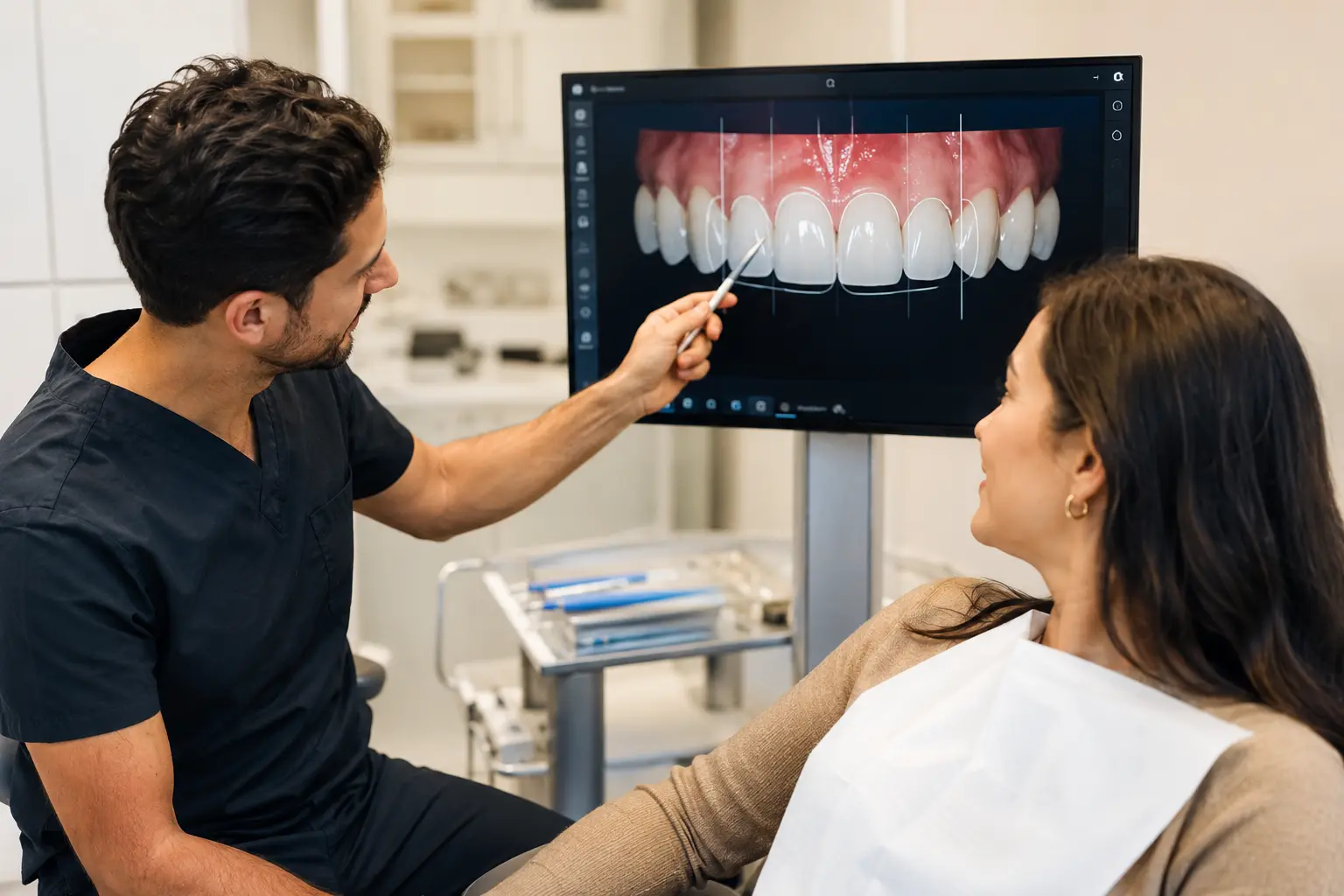
You catch your reflection and immediately look away, wishing your smile matched the confidence you feel inside, but digital smile design is changing everything by letting you see and approve your transformation before a single procedure happens.
Understanding digital smile design
Digital smile design represents a fundamental shift in how dentists approach aesthetic enhancement. Rather than relying on intuition or two-dimensional sketches, this technology uses advanced imaging software to create a detailed map of your facial structure, tooth position, and proportions. Imagine walking into a consultation and instead of hearing vague descriptions, you see a precise digital model of your mouth from multiple angles. The dentist can zoom in on individual teeth, adjust gum lines, and modify tooth shape in real time on a screen. This isn’t guesswork anymore. For women especially, who often balance multiple concerns about appearance alongside functionality, this approach offers transparency and control. You’re not trusting someone else’s vision of beauty; you’re collaborating to define what beauty means for your unique face. The software analyzes how your smile interacts with your lips, cheeks, and overall facial harmony, creating a treatment blueprint that’s genuinely personalized rather than cookie-cutter.
The biological basis of a beautiful smile
Beauty in a smile isn’t arbitrary or purely subjective. Decades of research in facial aesthetics have identified measurable biological principles that consistently appeal to human perception. The golden ratio, a mathematical proportion found throughout nature, appears in harmonious smiles. Your teeth should ideally occupy about 75 to 80 percent of your smile width, with proper spacing between them. The midline of your upper teeth should align with the center of your face. Gum display matters too; most people find a smile most attractive when the gum line shows minimally, typically less than 3 millimeters. The buccal corridors, those spaces between your teeth and cheeks when you smile, create visual balance. Women’s smiles often benefit from slightly more rounded tooth edges compared to sharper edges, which research suggests appears more approachable and youthful. Your jawline symmetry, the curve of your smile arc, and how your teeth relate to your lip line all contribute to overall attractiveness. Understanding these principles helps explain why certain adjustments feel right and why digital design can predict outcomes so accurately.
Key steps in the digital smile design process
The journey through digital smile design unfolds in distinct phases, each building on the previous one. During your initial consultation, your dentist goes beyond asking what you want. They listen for your concerns, understand your lifestyle, and discuss realistic expectations. This conversation is crucial because it shapes everything that follows. Next comes digital imaging, where high-resolution photographs and sometimes 3D scans capture your teeth, gums, lips, and face from multiple angles and expressions. You might smile naturally, show your teeth at rest, and demonstrate your full smile. Some offices use cone beam computed tomography for three-dimensional data. These images become the foundation for design. In the virtual design phase, your dentist uses specialized software to manipulate these images, showing you different tooth shapes, sizes, and positions. You might see how whitening alone would look, or how a slight adjustment to tooth length would change your appearance. This is where you provide feedback, requesting adjustments until the design matches your vision. Some practices even use augmented reality to overlay the proposed design onto your face in real time, letting you see the transformation from different angles and in various lighting conditions.
- Initial consultation and goal discussion
- High-resolution digital imaging and 3D scanning
- Virtual smile design and visualization
🔬 Science-backed benefits in 2 minuteschoose where to begin:
The role of technology in smile design
Modern dental technology has transformed smile design from an art form into a science-informed discipline. Three-dimensional imaging software creates precise measurements of your tooth dimensions, angulation, and position relative to your facial structure. Simulation software allows your dentist to test multiple treatment scenarios instantly. Want to see how your smile would look with veneers versus bonding? The software shows both options side by side. Some advanced systems use artificial intelligence to analyze your facial features and suggest proportions that would harmonize with your specific bone structure and skin tone. This technology enables predictability that was impossible just a decade ago. Your dentist can show you exactly what the final result will look like before beginning treatment, reducing surprises and ensuring you’re genuinely comfortable with the plan. The precision extends to treatment execution too. Digital designs guide the actual dental work, whether that involves orthodontics, veneers, bonding, or whitening. For women managing busy lives, this efficiency matters. You know what to expect, how long treatment takes, and what the investment will yield. The technology also creates a permanent record of your design, allowing adjustments if your preferences evolve.
Benefits of digital smile design
The advantages of this approach extend far beyond aesthetics. Communication between you and your dentist improves dramatically when you’re both looking at the same digital image and discussing specific changes. Misunderstandings diminish. You’re not imagining what the dentist described; you’re seeing it. This clarity reduces anxiety and builds confidence in the treatment plan. The predictability factor cannot be overstated. Traditional cosmetic dentistry often involved some uncertainty about final outcomes. Digital design removes that variable. You approve the design before any work begins, knowing exactly what you’re getting. This is particularly valuable for women who’ve experienced disappointment with previous dental work or who feel anxious about major changes to their appearance. The ability to visualize outcomes also helps you make informed decisions about treatment options. You can see the difference between subtle changes and dramatic transformations, helping you choose what feels right for your lifestyle and personality. Additionally, digital records allow your dentist to monitor your smile over time, making adjustments if needed and ensuring long-term satisfaction. The process also tends to be more efficient, potentially reducing overall treatment time and appointments.
A scientific approach to smile enhancement
Digital smile design represents the convergence of dental science, facial aesthetics research, and advanced technology. This integration has democratized access to sophisticated smile planning that was once available only in elite cosmetic practices. Women today can achieve results backed by scientific principles and technological precision, regardless of their location or previous dental history. The approach respects individual variation while applying universal principles of beauty and harmony. Your smile enhancement isn’t imposed on you; it’s designed with you, reflecting your values, personality, and goals. The science ensures that changes don’t just look good in isolation but integrate seamlessly with your overall facial structure and expression. This holistic perspective means your enhanced smile will look naturally beautiful, not overdone or artificial. As technology continues evolving, digital smile design becomes increasingly accessible and refined. More dentists are adopting these tools, making sophisticated smile planning available to more women. The combination of scientific understanding, personalized design, and precise execution represents the modern standard for cosmetic dentistry. You’re not just getting a cosmetic procedure; you’re receiving a scientifically informed, individually tailored enhancement that respects both the art and science of beautiful smiles.
Digital smile design utilizes advanced technology to analyze, plan, and enhance the aesthetics of a smile. By combining digital imaging with facial analysis, dentists can create personalized treatment plans that optimize the harmony and beauty of each individual’s smile.
Is digital smile design suitable for everyone?
Digital smile design is a versatile technique that can benefit individuals seeking to enhance the aesthetics of their smile. Your dentist will assess your unique needs and goals to determine if this approach is suitable for you.
How long does the digital smile design process take?
The duration of the digital smile design process varies depending on individual factors and treatment complexity. Your dentist will provide a timeline specific to your treatment plan during the initial consultation.
Others also read:
Disclaimer: This article is for informational purposes only and is not a substitute for professional medical advice. Always consult a healthcare professional for personal guidance.
This article has been prepared and reviewed by the GlobalHealthBeacon editorial team and is based on current medical research and published scientific literature available in 2026. It provides structured, evidence-based information to support informed health decisions.
