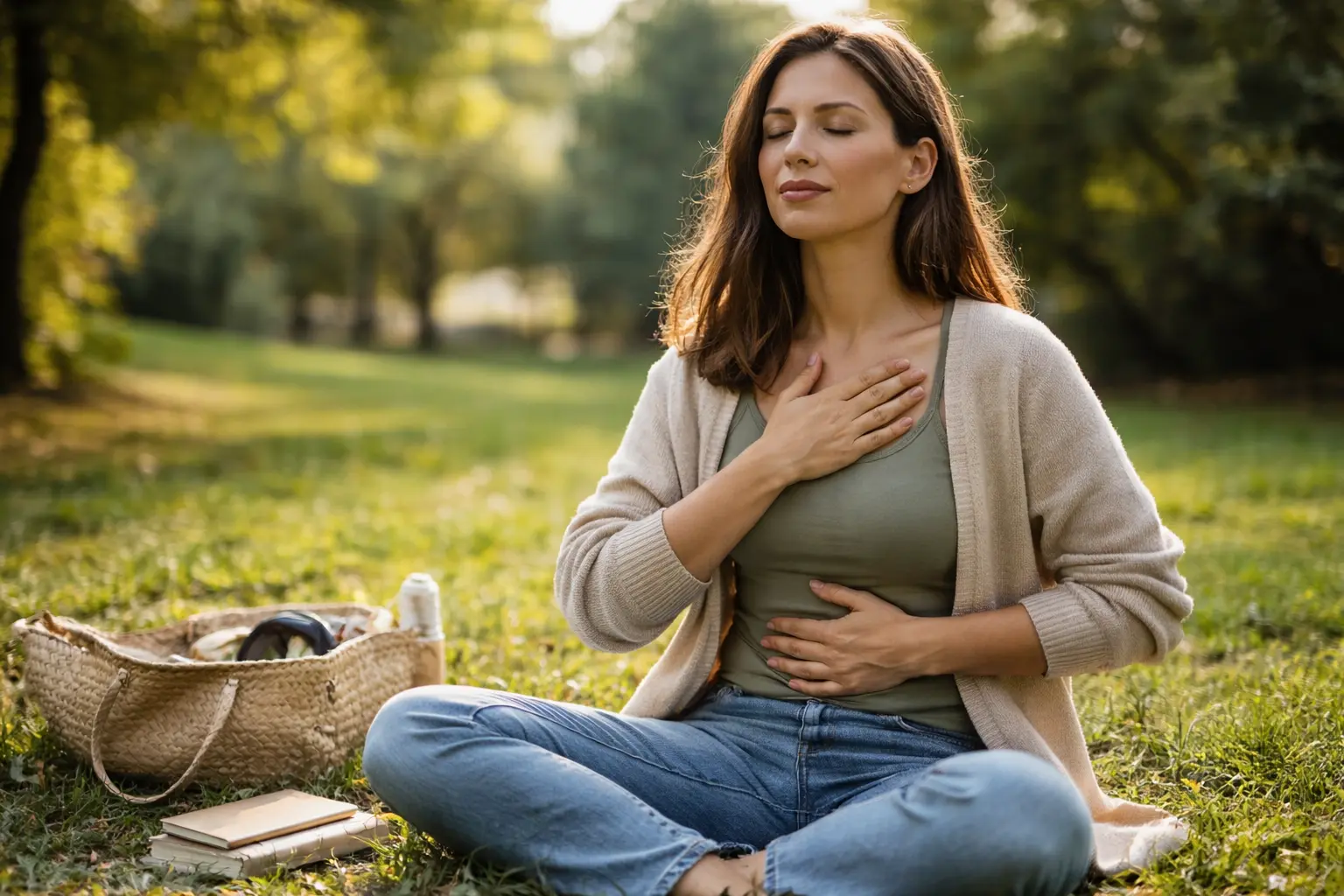
Your chest tightens, your mind races, and suddenly the world feels too much to handle, but grounding techniques for anxiety can pull you back to solid ground and help you breathe again.
Deep breathing techniques
Deep breathing is one of the most accessible and powerful tools you have right at your fingertips. When anxiety hits, your breathing becomes shallow and rapid, which signals your body to stay in fight-or-flight mode. By intentionally slowing your breath, you send a message to your nervous system that you are safe. Start by finding a comfortable seated position, perhaps in your favorite chair. Breathe in slowly through your nose for a count of four, allowing your belly to expand rather than just your chest. Hold that breath for another count of four, noticing the stillness. Then exhale through your mouth for a count of four, letting tension leave your body with each breath. Repeat this cycle five to ten times. Many seniors find this technique works best when practiced in a quiet space, perhaps in the morning or before bed. Some people pair it with a peaceful image, like sitting by a lake or walking through a garden, to deepen the calming effect.
- Inhale deeply through your nose for a count of four
- Hold your breath for another count of four
- Exhale slowly through your mouth for a count of four
- Repeat the cycle several times to calm your mind
Grounding objects
A grounding object serves as an anchor to the present moment when your mind drifts into worry. This could be a smooth stone from a beach you love, a worry bead, a piece of soft fabric, or even a favorite piece of jewelry. The key is choosing something small enough to carry with you and pleasant to touch. When anxiety creeps in, hold this object in your hand and focus entirely on how it feels. Notice its temperature, texture, weight, and shape. Is it smooth or slightly rough? Warm or cool? This sensory engagement redirects your attention away from anxious thoughts and back to what is real and present. Some seniors keep a grounding object on their nightstand for moments when anxiety disrupts sleep, or in a pocket during doctor appointments when nervousness tends to rise. The object becomes a silent companion that reminds you that you have tools to manage difficult moments.
📘 Fix your day in under 2 minuteschoose where to begin:
Mindful walking
Walking is something you likely do every day, but mindful walking transforms an ordinary activity into a powerful anxiety management tool. Rather than walking on autopilot while your mind worries, you bring full awareness to each step and sensation. Begin by taking a slow, deliberate walk, either indoors around your home or outdoors in a safe, familiar place. With each step, notice the feeling of your foot touching the ground. Pay attention to the movement of your legs, the swing of your arms, and the rhythm of your body. Expand your awareness to include what you see around you: the colors, the light, the shapes of trees or buildings. Listen to the sounds in your environment, whether birds, wind, or distant traffic. This multi-sensory focus keeps your mind engaged in the present rather than spiraling into worry. Many seniors find that a 10 to 15 minute mindful walk in the morning or late afternoon provides relief and improves their overall mood for hours afterward.
Muscle relaxation
Progressive muscle relaxation works by releasing the physical tension that anxiety creates in your body. Anxiety often manifests as tight shoulders, clenched fists, or a tense jaw, and you may not even realize how much tension you are holding. This technique asks you to deliberately tense and then relax each muscle group, which teaches your body the difference between tension and relaxation. Start by sitting or lying down comfortably. Begin with your toes: tense them tightly for a count of five, then release and notice the relief. Move up through your feet, calves, thighs, and buttocks, following the same pattern. Continue through your abdomen, chest, hands, arms, shoulders, neck, and face. Spend extra time on areas where you typically hold stress. The entire process takes about 15 to 20 minutes. Regular practice trains your body to recognize and release tension more quickly, so that over time, you can calm anxiety before it builds to overwhelming levels.
Positive affirmations
Anxiety often brings a flood of negative thoughts: I cannot handle this, something bad will happen, I am losing control. Positive affirmations directly counter these patterns by replacing them with calm, grounding statements. Choose affirmations that resonate with you personally. Common ones include I am safe, I am calm, I am in control, This feeling will pass, or I have handled difficult moments before. Repeat your chosen affirmation slowly and deliberately, either silently or aloud, whenever anxiety arises. Some seniors write their affirmations on index cards and place them on the bathroom mirror, refrigerator, or bedside table as visual reminders. Others repeat them during their morning routine or while taking their grounding object in hand. The repetition gradually shifts your mindset from fear to reassurance. Over time, these affirmations become automatic thoughts that interrupt the anxiety cycle before it spirals, helping you maintain a sense of security and control even during challenging moments.
Discover natural grounding techniques like deep breathing, using grounding objects, mindful walking, muscle relaxation, and positive affirmations to ease anxiety and find peace amidst challenges.
How long should I practice these grounding techniques?
It is recommended to practice these techniques for at least 5 to 10 minutes whenever you feel overwhelmed by anxiety to help relax your mind and body. Some seniors benefit from shorter sessions of 2 to 3 minutes throughout the day, while others prefer one longer session. Consistency matters more than duration.
Can grounding techniques be used in combination with other anxiety management strategies?
Yes, grounding techniques can be integrated into your overall anxiety management plan to enhance relaxation and promote a sense of calm during stressful moments. They work well alongside professional counseling, medication, exercise, and social connection.
Others also read:
Disclaimer: This article is for informational purposes only and is not a substitute for professional medical advice. Always consult a healthcare professional for personal guidance.
This guide has been prepared and reviewed by the GlobalHealthBeacon editorial team and reflects current medical research as of 2026. It provides structured, evidence-based information to support informed health decisions.
