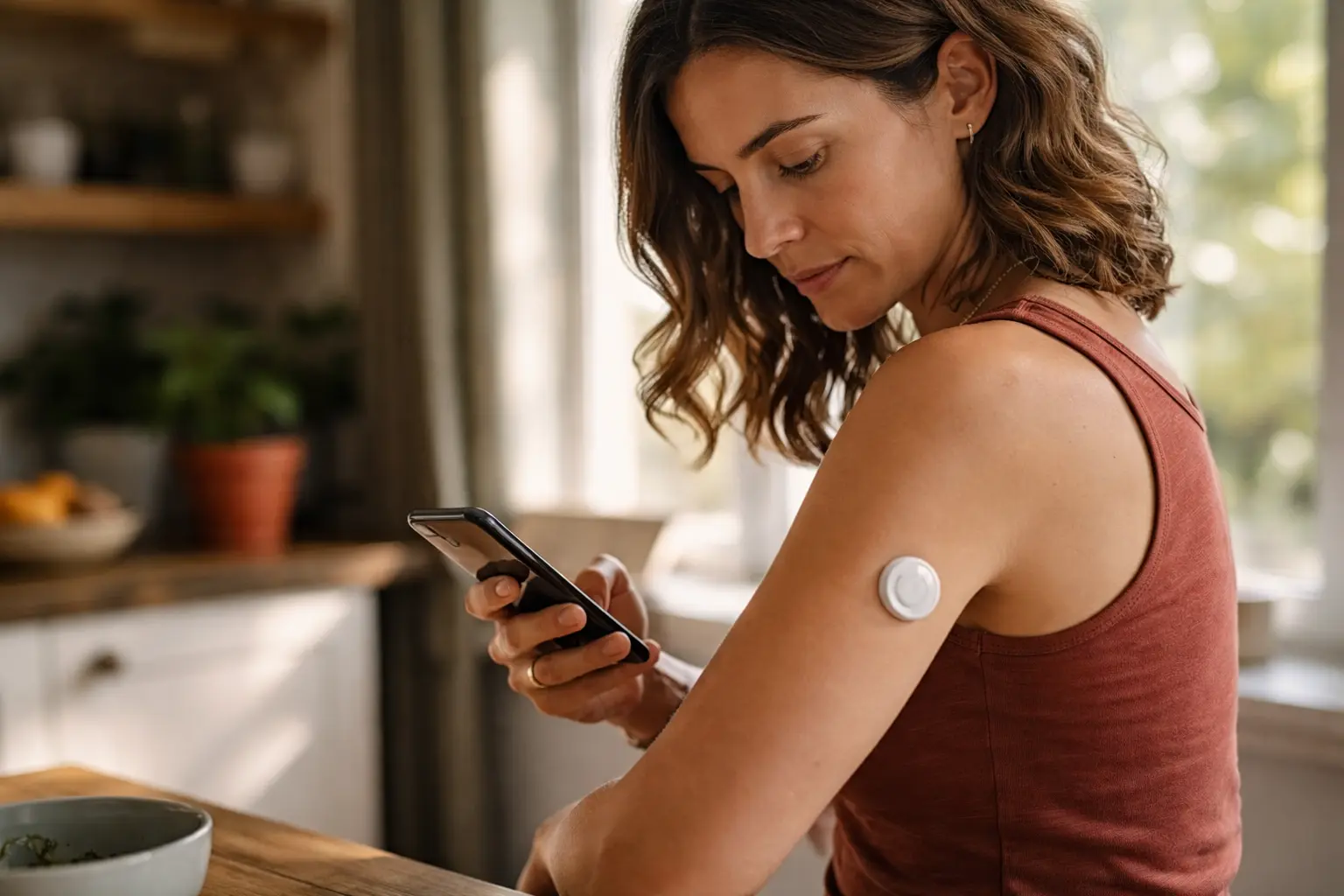
Tired of guessing whether that afternoon energy crash is blood sugar or just stress, or wondering why your energy levels feel like a rollercoaster throughout the day? A continuous glucose monitor explained simply reveals exactly what’s happening inside your body in real time, turning invisible glucose fluctuations into actionable data you can actually understand and work with.
Understanding continuous glucose monitoring
Continuous glucose monitoring, or CGM, represents a fundamental shift in how we track metabolic health. Rather than relying on occasional finger-prick tests that capture only a single moment in time, CGM technology provides a dynamic, real-time picture of your glucose levels across the entire day and night. Imagine having a personal metabolic assistant that watches your blood sugar 24/7, recording how it responds to breakfast, your afternoon workout, stress from a work meeting, or even that glass of wine with dinner. For many women, this visibility is transformative. You start noticing patterns you never saw before: perhaps your glucose spikes higher after certain foods than you expected, or dips lower during specific times of day. Some women discover that their energy crashes aren’t random at all, but directly tied to glucose fluctuations. This continuous stream of data empowers you to move beyond generic dietary advice and instead make choices based on how your unique body actually responds.
How CGM sensors operate
The technology behind CGM sensors is elegantly simple yet remarkably sophisticated. A tiny electrode, thinner than a hair, is inserted just beneath your skin, typically on your abdomen or arm. This electrode sits in the interstitial fluid, the clear liquid that bathes your cells and sits between your bloodstream and your tissues. This fluid is in constant equilibrium with your blood, so glucose levels here mirror what’s happening in your circulation, though with a slight time delay of about 5 to 15 minutes. The sensor continuously measures glucose concentration and transmits this data wirelessly to a receiver or your smartphone, updating your readings every few minutes. The beauty of this approach is that it bypasses the need for painful finger sticks while providing vastly more information. Women often appreciate this aspect, especially those managing conditions where frequent monitoring is essential. The sensor itself is waterproof and designed to stay securely in place for 10 to 14 days, depending on the brand, before needing replacement.
Key steps in using CGM sensors
Getting started with a CGM involves several straightforward steps, though the exact process varies slightly depending on which system you choose. First, you select an appropriate placement site, ideally an area with adequate subcutaneous tissue and minimal movement, such as the back of your upper arm or your abdomen. Clean the area thoroughly with soap and water, then dry it completely, as moisture can interfere with sensor adhesion. Next, you activate the sensor according to manufacturer instructions, which typically involves removing a protective cap and pressing the applicator firmly against your skin to insert the tiny electrode. Most systems require a brief warm-up period of 10 to 15 minutes before readings begin. Some CGM systems require calibration by entering a fingerstick glucose value, while newer models use factory calibration and skip this step entirely. Once activated, you pair the sensor with your receiver or smartphone app, and you’re ready to begin monitoring. A common mistake women make is not allowing adequate time for the sensor to stabilize before trusting the readings completely, or placing the sensor in areas prone to compression, such as directly under a bra strap or tight waistband, which can distort readings.
- Choose a clean, dry placement site with adequate tissue, such as your abdomen or upper arm.
- Prepare the skin by cleaning and drying thoroughly to ensure proper sensor adhesion.
- Insert the sensor using the applicator and allow 10 to 15 minutes for warm-up and stabilization.
- Calibrate the sensor if required by your specific CGM system, or confirm factory calibration.
- Pair the sensor with your receiver or smartphone app to begin receiving glucose readings.
- Check sensor placement daily and replace as recommended by the manufacturer, typically every 10 to 14 days.
🔬 Science-backed benefits in 2 minuteschoose where to begin:
Benefits of continuous glucose monitoring
The advantages of CGM extend far beyond simple glucose tracking. For women managing diabetes or prediabetes, CGM provides the detailed information needed to optimize medication timing and dosing. But even for those without a diabetes diagnosis, the insights are profound. You discover which foods genuinely work for your body and which ones, despite being marketed as healthy, leave you feeling sluggish or hungry an hour later. You see how exercise affects your glucose in real time, whether a 20-minute walk after meals significantly blunts the post-meal spike, or whether you need more intense activity to see meaningful changes. Stress becomes visible too, as you notice how a difficult conversation or deadline causes your glucose to rise even without eating. Women often use this information to make lifestyle adjustments that feel personalized rather than generic. Some find that adding protein to breakfast eliminates their mid-morning energy crash. Others discover that a short walk after dinner prevents the evening glucose spike that was disrupting their sleep. This proactive, data-driven approach transforms glucose management from a source of anxiety into a concrete, manageable aspect of daily life.
Limitations and considerations
While CGM technology is remarkably useful, it’s important to understand its limitations to interpret your data accurately. CGM sensors measure glucose in interstitial fluid, not blood, which means readings lag behind actual blood glucose by about 5 to 15 minutes. During rapid glucose changes, such as immediately after eating or during intense exercise, this delay can feel noticeable. Sensor accuracy also varies based on several factors. Dehydration can concentrate glucose in interstitial fluid, potentially causing falsely elevated readings. Compression of the sensor site, whether from tight clothing, sleeping on the sensor, or even pressure from a seatbelt, can distort readings. Some women notice that sensor accuracy drifts slightly as the sensor ages, with readings becoming less reliable toward the end of the two-week wear period. Certain medications, particularly corticosteroids, can affect glucose readings. Additionally, factors like menstrual cycle phase, hormonal fluctuations, and even the specific location where you place the sensor can influence readings. Understanding these variables helps you avoid misinterpreting data and making unnecessary changes based on sensor artifacts rather than true glucose patterns.
Future perspectives for CGM technology
The CGM landscape is evolving rapidly, with researchers and manufacturers working to address current limitations and expand capabilities. Upcoming generations of sensors aim for improved accuracy, particularly during rapid glucose changes, and some are exploring non-invasive or minimally invasive alternatives that don’t require subcutaneous insertion. Sensor size continues to shrink, making devices even more discreet and comfortable for long-term wear. Integration with artificial intelligence and machine learning is beginning to offer predictive insights, potentially alerting you to glucose patterns before they occur rather than only showing you what’s happening in real time. For women specifically, researchers are investigating how hormonal fluctuations throughout the menstrual cycle affect glucose patterns and how CGM data can be interpreted differently based on cycle phase. Some companies are developing closed-loop systems that combine CGM data with automated insulin delivery, though these remain primarily in the diabetes management space for now. The broader vision is a future where personalized metabolic monitoring becomes as routine as checking your steps or heart rate, offering women detailed insights into how their unique biology responds to food, movement, stress, and sleep.
Continuous glucose monitoring through CGM sensors offers real-time data on glucose levels, empowering users to make informed decisions about their health. Understanding the operation, benefits, and limitations of these devices is key to optimal glucose management.
Are CGM sensors painful to use?
Most users report minimal discomfort when inserting CGM sensors, likening it to a quick prick or pinch. The convenience of continuous glucose monitoring usually outweighs any minor discomfort.
Can CGM sensors be worn during physical activities?
Yes, CGM sensors are designed to be worn during various physical activities, including exercise and sports. Proper sensor placement and secure attachment are essential for accurate readings during movement.
Others also read:
Disclaimer: This article is for informational purposes only and is not a substitute for professional medical advice. Always consult a healthcare professional for personal guidance.
This article has been prepared and reviewed by the GlobalHealthBeacon editorial team and is based on current medical research and published scientific literature available in 2026. It provides structured, evidence-based information to support informed health decisions.
← Back to the Main page on: continuous glucose monitor explained
