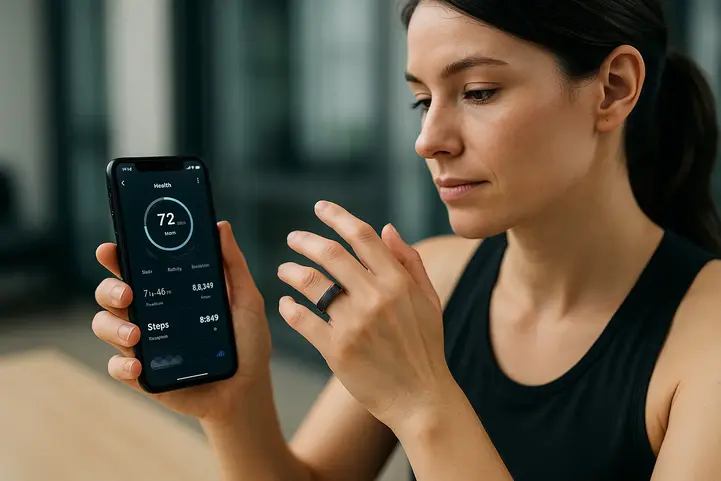
You’ve been tracking your heart rate all week, but something feels off when you compare your smart ring data to what your doctor’s office measured, and now you’re wondering if smart rings ppg accuracy is actually reliable enough to trust.
Understanding smart ring technology
Smart rings have become increasingly popular among women seeking convenient ways to monitor their health without the bulk of traditional wearables. At their core, these devices use photoplethysmography, or PPG, a non-invasive optical technique that measures blood flow patterns through your skin. When you wear a smart ring, tiny LED lights shine through the skin on your finger, and sensors detect how much light bounces back. This works because blood absorbs light differently than surrounding tissue. As your heart pumps, blood volume in your capillaries changes rhythmically, creating a pattern that the ring’s sensors capture thousands of times per second. Think of it like a tiny light show happening beneath your skin every moment. For women specifically, this technology offers a discreet way to gather health data without drawing attention, making it easier to wear consistently throughout daily activities, workouts, and sleep.
The science behind PPG accuracy
Understanding how PPG sensors actually work helps explain why accuracy varies so much between devices and individuals. The sensors in smart rings measure the pulsatile component of blood flow, which is the rhythmic change in blood volume with each heartbeat. This signal gets processed through algorithms that filter out noise and calculate your heart rate, heart rate variability, and other metrics. However, the journey from raw light measurement to meaningful health data is complex. The algorithms must distinguish between genuine cardiac signals and false signals caused by movement, ambient light, or sensor drift. Women’s physiology adds another layer of consideration, as hormonal fluctuations throughout the menstrual cycle can subtly affect heart rate patterns and blood flow characteristics. Research shows that PPG accuracy in consumer devices typically ranges from 85 to 95 percent when compared to medical-grade electrocardiograms, but this varies significantly based on individual factors and wearing conditions.
Factors influencing smart ring accuracy
Multiple interconnected factors determine whether your smart ring gives you reliable readings or misleading data. Skin contact quality is foundational, as even tiny gaps between the sensor and your skin can disrupt the light path and create artifacts. For women with smaller fingers or those who prefer looser jewelry, finding the right fit becomes a practical challenge. Skin tone significantly impacts PPG accuracy because melanin absorbs light differently than lighter skin, meaning women with darker skin tones may experience systematically lower accuracy rates with some devices. This is not a minor issue, it is a documented limitation that affects the validity of your personal health data. Motion introduces another major source of error, especially during exercise when your ring bounces slightly with each step or movement. Environmental factors like bright sunlight or reflective surfaces can confuse sensors. Additionally, certain skin conditions, tattoos, or nail polish can interfere with light transmission. Women taking medications that affect blood vessel function, or those experiencing conditions like Raynaud’s phenomenon, may see more variable readings.
- Achieve a snug fit that sits firmly on your finger without cutting off circulation, checking that you can slide only one finger underneath the band.
- Consider your skin tone when setting baseline expectations, understanding that darker skin may require device-specific calibration or acceptance of wider accuracy margins.
- Avoid excessive movement during critical measurement periods like sleep tracking, and keep your hand still for at least 30 seconds when taking deliberate readings.
- Minimize exposure to direct sunlight or highly reflective surfaces when wearing your ring for important measurements.
- Monitor your readings over time to identify personal patterns and anomalies rather than trusting individual data points.
🔬 Science-backed benefits in 2 minuteschoose where to begin:
Interpreting PPG data
Once your smart ring collects PPG data, the real work of interpretation begins. The device typically provides heart rate, heart rate variability (HRV), and sleep stage information. Heart rate is straightforward, showing your beats per minute, but HRV is more nuanced and reflects the variation in time between heartbeats, which correlates with nervous system balance and recovery status. For women, understanding these metrics requires context. Your resting heart rate naturally fluctuates throughout your menstrual cycle, typically rising slightly during the luteal phase due to progesterone’s effects on metabolism. Sleep data from PPG can show you time in different sleep stages, though this relies on algorithms that estimate stages based on heart rate patterns rather than brain activity measurements. Many women find value in tracking trends over weeks and months, noticing how stress, exercise, sleep quality, and hormonal phases influence their metrics. The key is viewing your ring as a personal feedback tool that reveals patterns about your body’s responses, rather than as a medical diagnostic device delivering absolute truth.
Limitations of smart ring accuracy
Being honest about what smart rings cannot do is just as important as understanding what they can. Consumer-grade PPG devices are fundamentally different from medical-grade equipment like hospital monitors or clinical-grade pulse oximeters. Medical devices undergo rigorous validation testing across diverse populations, while many consumer smart rings have been tested on limited demographic groups, often skewing toward younger, lighter-skinned populations. This creates a real accuracy gap for women outside these narrow testing parameters. Smart rings cannot detect arrhythmias with the precision of an ECG, cannot measure blood pressure, and cannot diagnose cardiac conditions. Their readings can drift over time as sensors age or as your skin changes. Environmental factors like extreme heat, cold, or humidity can degrade accuracy. For women with certain medical conditions, pregnancy, or those taking specific medications, smart ring data may be less reliable. The algorithms are proprietary and often opaque, meaning you cannot fully understand how your personal data becomes the numbers on your screen. Using smart ring data to make medical decisions without professional verification could lead to unnecessary worry or missed diagnoses.
Evaluating smart ring benefits
Despite their limitations, smart rings offer genuine value for women interested in personal health tracking and self-awareness. The convenience factor is significant, as wearing a ring requires no special setup, no chest straps, and no conscious effort beyond putting it on your finger. This ease of use means women are more likely to wear the device consistently, generating continuous data streams that reveal authentic patterns in daily life. Tracking fitness goals becomes more intuitive when you can see how different workouts affect your heart rate recovery, a metric that improves with cardiovascular fitness. Sleep quality monitoring helps many women identify which habits, foods, or activities genuinely impact their rest, moving beyond subjective feelings to observable data. Stress level indicators, while not medically precise, can serve as useful reminders to pause and breathe when your body signals activation. The longitudinal nature of smart ring data, collected over months and years, creates a personal health baseline that you can share with healthcare providers for context during medical appointments. For women seeking to understand their bodies better and take an active role in their health, smart rings function as accessible entry points into health literacy and self-monitoring.
Smart rings employ PPG technology to measure blood flow and heart rate patterns, offering women a convenient way to track personal health metrics. Accuracy depends on multiple factors including proper fit, skin tone, movement, and environmental conditions. While these devices excel at revealing trends and patterns over time, they should not replace medical-grade equipment for diagnostic purposes. Understanding both the capabilities and limitations of your smart ring helps you interpret data meaningfully and use it as a complementary tool within your broader health awareness.
Can smart rings replace medical-grade devices for health monitoring?
Smart rings provide valuable convenience and trend data but lack the clinical validation and precision of medical-grade devices. They work best as complementary tools that increase your awareness of personal health patterns. For any health concerns or medical decisions, professional medical devices and healthcare provider assessment remain essential.
How important is skin tone in the accuracy of PPG readings?
Skin tone significantly impacts PPG accuracy because melanin absorbs light differently than lighter skin. Women with darker skin tones may experience systematically lower accuracy rates with some devices. This is a documented limitation that affects data reliability, and users should be aware that their personal readings may have wider margins of error than those of lighter-skinned users.
Others also read:
Disclaimer: This article is for informational purposes only and is not a substitute for professional medical advice. Always consult a healthcare professional for personal guidance.
This article has been prepared and reviewed by the GlobalHealthBeacon editorial team and is based on current medical research and published scientific literature available in 2026. It provides structured, evidence-based information to support informed health decisions.
