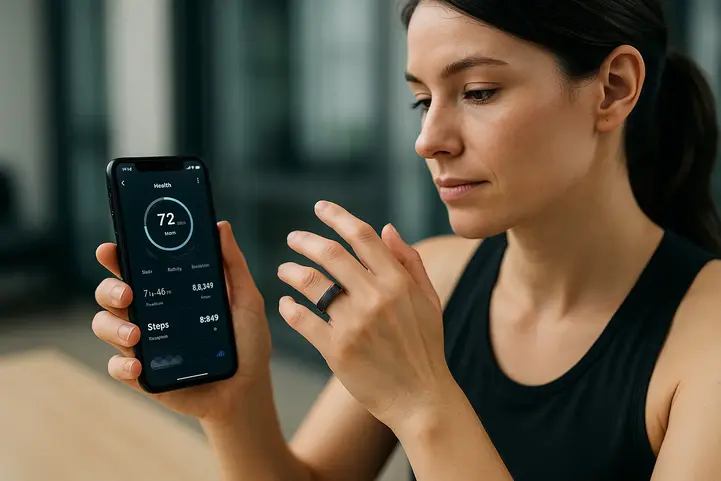
You’re tracking your heart rate with a smart ring, but deep down you’re wondering if those numbers actually mean anything – and that nagging doubt about smart rings PPG accuracy is eating at you because you’re relying on this data to understand your health.
Understanding smart rings PPG technology
Photoplethysmography, or PPG, works through a surprisingly elegant biological principle. Inside your smart ring sits a light-emitting diode, typically in the red or infrared spectrum, that shines through the skin on your finger. As blood pulses through the tiny blood vessels beneath the surface, it absorbs varying amounts of that light. A photodiode on the opposite side of the sensor detects these fluctuations in light reflection and absorption. Think of it like watching shadows dance across a wall as clouds pass overhead. Your blood volume changes with each heartbeat, creating a rhythmic pattern that the ring’s processor translates into heart rate data. This same principle extends to measuring blood oxygen saturation, where different wavelengths of light penetrate tissue at different depths, allowing the device to estimate how much oxygen your red blood cells are carrying. The technology has been around for decades in medical settings, but miniaturizing it into a wearable ring required significant engineering innovation.
Factors influencing PPG accuracy
The accuracy of your smart ring’s PPG readings depends on a constellation of factors working together. Skin pigmentation plays a measurable role because melanin absorbs light differently than lighter skin tones, potentially affecting how well the sensor can detect blood volume changes. This isn’t a flaw in the technology itself, but rather a reminder that wearable health devices have been primarily tested on limited demographic groups. Ambient lighting matters too. If you’re wearing your ring in bright sunlight, the external light can interfere with the sensor’s ability to detect the subtle light changes from your blood flow. Motion artifacts represent another challenge. When you’re moving your hand or finger, the sensor struggles to distinguish between movement noise and actual blood flow signals. Even something as simple as a loose ring fit can introduce errors, because inconsistent contact between the sensor and your skin creates gaps in the optical pathway. Temperature fluctuations, caffeine intake, and even your stress level can influence peripheral blood flow, which directly impacts what the sensor detects.
Key points for ensuring accurate PPG readings
Getting reliable data from your smart ring requires understanding the practical mechanics of how the device works. The sensor needs consistent, firm contact with your skin to create a stable optical pathway. A ring that’s too loose will shift with every movement, introducing noise into the signal. Conversely, one that’s uncomfortably tight can restrict blood flow, which ironically makes readings less accurate. During measurements, especially when you’re checking your resting heart rate or blood oxygen, staying still for at least 30 seconds allows the algorithm to collect enough data points to filter out movement artifacts and calculate a stable average. Environmental conditions matter more than many users realize. Measuring in a dimly lit room with stable temperature gives your sensor the best chance of capturing clean data. If you’re outdoors in bright sunlight or in a cold environment where your peripheral circulation has constricted, expect less reliable readings. Some users find that keeping a simple log of when they take measurements and under what conditions helps them understand their device’s performance patterns over time.
- Ensure a snug fit for the smart ring on your finger, positioned over the blood vessels on the inner side of your finger.
- Stay stationary during PPG measurements for at least 30 seconds to allow the sensor to collect sufficient data points.
- Be mindful of lighting conditions when using the smart ring, avoiding direct sunlight or extremely dim environments.
🔬 Science-backed benefits in 2 minuteschoose where to begin:
Comparing smart rings PPG accuracy to traditional devices
Smart rings offer a fundamentally different value proposition than traditional medical devices like pulse oximeters or chest-strap heart rate monitors. A clinical pulse oximeter, typically used in hospitals, has been validated through rigorous testing and can achieve accuracy within 2-3% of actual blood oxygen levels. Smart rings, by contrast, provide estimates that may vary by 5-10% or more depending on individual factors and conditions. However, smart rings excel at continuous monitoring. You can check your heart rate dozens of times throughout the day without thinking about it, whereas you’d never clip on a pulse oximeter just to check your resting heart rate. This continuous data collection reveals patterns that single-point measurements miss. A young adult might notice their resting heart rate gradually increasing over weeks, signaling overtraining or stress, even if individual readings vary slightly. The trade-off is clear: smart rings sacrifice clinical-grade precision for convenience and continuous insight. For general health awareness and trend tracking, they’re genuinely useful. For diagnosing specific medical conditions, they’re a starting point for conversation with a healthcare provider, not a replacement for clinical testing.
Enhancing PPG accuracy through calibration and validation
Many smart ring manufacturers include calibration features that let you improve accuracy over time. The basic approach involves comparing your ring’s reading to a reference measurement from a clinical device, then allowing the algorithm to adjust its calculations based on your individual physiology. Some rings use machine learning to personalize their algorithms to your specific skin tone, blood flow patterns, and sensor characteristics. Validation studies have become increasingly important as these devices proliferate. When researchers compare smart ring data to simultaneous measurements from clinical-grade equipment across diverse populations, they’re essentially stress-testing the technology. Recent studies show that accuracy varies significantly based on activity level, skin tone, and individual factors like tattoos or scars near the sensor. The most honest assessment is that smart rings provide useful directional data and trend information, but shouldn’t be treated as clinical instruments for individual readings. If you’re considering using your smart ring data to make health decisions, comparing a few readings to a clinical device gives you a baseline understanding of your device’s accuracy in your specific circumstances.
The future of smart rings PPG accuracy
The trajectory of smart ring technology suggests meaningful improvements ahead. Researchers are developing multi-wavelength sensors that use more light frequencies simultaneously, potentially improving accuracy across diverse skin tones and conditions. Artificial intelligence algorithms are becoming more sophisticated at filtering out noise and distinguishing true physiological signals from artifacts. Some manufacturers are exploring additional sensors, like temperature and electrocardiogram capabilities, that provide complementary data to improve overall accuracy. The competitive landscape is also driving innovation. As more companies enter the smart ring market, each is motivated to claim superior accuracy, pushing the entire industry toward better sensor design and algorithm refinement. Within the next few years, expect smart rings to become noticeably more reliable, particularly for continuous heart rate monitoring and basic blood oxygen estimation. The real game-changer will be when these devices achieve sufficient accuracy to detect subtle health changes early, potentially alerting users to conditions before symptoms appear. For young adults, this means the smart ring you buy today will likely be surpassed by significantly more accurate versions within three to five years.
Smart rings utilize PPG technology to measure blood volume changes and provide insights into vital signs. Factors like skin pigmentation and sensor placement can influence the accuracy of PPG readings. Calibrating devices and understanding environmental influences are key to ensuring reliable data.
Can smart rings accurately measure heart rate and blood oxygen levels?
Smart rings can provide estimates of heart rate and blood oxygen levels, but their accuracy may be affected by various factors such as skin pigmentation and sensor placement.
How can I improve the accuracy of PPG readings from my smart ring?
To enhance the accuracy of PPG readings, ensure proper sensor contact with the skin, minimize motion artifacts, and consider environmental factors like lighting conditions.
Others also read:
Disclaimer: This article is for informational purposes only and is not a substitute for professional medical advice. Always consult a healthcare professional for personal guidance.
This article has been prepared and reviewed by the GlobalHealthBeacon editorial team and is based on current medical research and published scientific literature available in 2026. It provides structured, evidence-based information to support informed health decisions.
