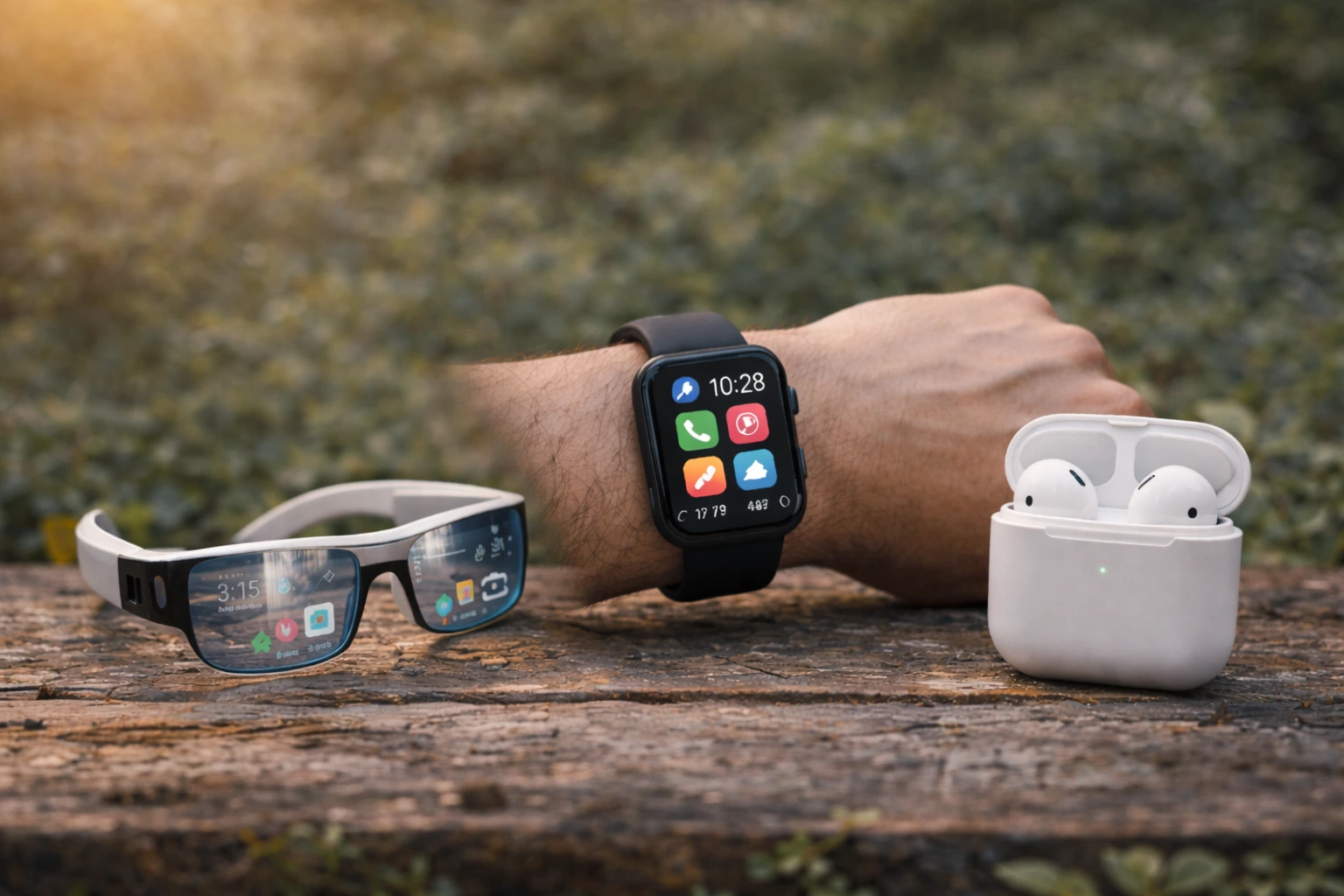
Stuck staring at a tiny screen all day, feeling tethered to a device that drains your battery and your attention span? The technologies replacing mobile phones are finally here, and they’re about to completely reshape how you stay connected without the constant digital weight.
Biometric wearables: the future of connectivity
Biometric wearables represent a fundamental shift in how we interact with technology by moving beyond the traditional smartphone model. Devices like smartwatches, fitness rings, and health-monitoring bracelets integrate continuous health tracking with seamless communication capabilities. Imagine starting your morning: your wearable tracks your sleep quality, heart rate variability, and stress levels while simultaneously delivering important notifications directly to your wrist. Unlike a smartphone that demands your visual attention, these devices provide information passively through haptic feedback or subtle vibrations. For women managing multiple responsibilities, this means staying informed without the constant pull of a screen. A practical example is a busy professional who receives urgent messages through her smartwatch while in meetings, responding with voice commands rather than fumbling for her phone. The technology learns your patterns over time, filtering notifications based on context and importance. Common mistakes include ignoring the battery life limitations of early models or not properly syncing health data across platforms. Modern wearables now offer multi-day battery life and sophisticated health insights that rival dedicated medical devices.
Virtual reality (VR): immersive communication
Virtual reality technology transcends the limitations of traditional smartphone screens by creating fully immersive digital environments where communication feels genuinely present. Rather than video calls on a flat display, VR enables you to meet colleagues, friends, or family in shared virtual spaces that feel remarkably lifelike. Picture attending a business meeting where participants appear as realistic avatars in a virtual conference room, complete with body language and spatial awareness. The technology uses headsets equipped with motion tracking, allowing natural gestures and eye contact simulation. For women in remote work situations, VR meetings reduce the fatigue associated with traditional video calls because the brain processes the interaction more naturally. Beyond professional use, VR enables interactive storytelling experiences where you become part of the narrative rather than passively consuming content. Educational applications allow women to explore complex subjects through experiential learning. A common misconception is that VR requires expensive equipment, though affordable options now exist. The technology also addresses privacy concerns differently than smartphones, as your physical location remains hidden while your avatar represents you in virtual space.
Holographic displays: transforming visual communication
Holographic display technology creates three-dimensional visual representations that appear to float in physical space, fundamentally changing how we perceive and interact with digital information. Unlike traditional screens that flatten content into two dimensions, holograms use light diffraction and interference patterns to generate images with genuine depth and spatial presence. Consider a scenario where a woman receives a holographic message from a loved one that appears as a three-dimensional figure in her living room, creating an emotional connection far deeper than a text message or video call. Medical professionals use holographic displays to examine patient scans in three dimensions, improving diagnostic accuracy. The underlying technology involves sophisticated algorithms that calculate light paths and create interference patterns visible to the human eye without requiring special glasses. Architects and designers use holograms to present projects with unprecedented clarity and detail. A practical advantage for women managing households is the ability to view recipes, instructions, or tutorials as three-dimensional holograms that can be rotated and examined from multiple angles. Early adopters report that holographic communication feels more intimate and engaging than traditional digital interaction. The technology continues evolving, with costs decreasing and accessibility improving significantly.
- Explore the latest holographic display devices on the market.
- Learn about the underlying technology behind holographic imaging.
- Experiment with interactive holographic experiences to understand their potential.
🔬 Science-backed benefits in 2 minuteschoose where to begin:
Brain-computer interfaces (BCIs): mind-controlled devices
Brain-computer interfaces represent the frontier of hands-free technology by establishing direct communication pathways between your neural activity and digital devices. These systems use non-invasive sensors to detect electrical signals from your brain, translating them into commands without requiring physical touch or voice input. For women with mobility limitations or those managing conditions affecting motor control, BCIs offer unprecedented independence and accessibility. Imagine typing a message or controlling your home environment using only your thoughts, without touching a keyboard or screen. Current research demonstrates that BCIs can achieve remarkable accuracy, with users learning to control cursors, robotic limbs, or communication devices through focused intention. The technology relies on machine learning algorithms that adapt to individual neural patterns, becoming more accurate with practice. A practical application involves women who experience repetitive strain injuries from excessive smartphone use being able to interact with technology without physical contact. Early clinical trials show BCIs helping individuals with paralysis regain communication abilities. Common concerns about privacy and data security are being addressed through encryption protocols and user-controlled data management. The technology remains in development stages for consumer applications, but the trajectory suggests significant accessibility improvements ahead.
Artificial intelligence (AI): personalized digital assistants
Artificial intelligence powers digital assistants that understand context, learn preferences, and anticipate needs without requiring constant user input or smartphone interaction. Modern AI systems process natural language, recognize patterns in your behavior, and provide personalized recommendations across health, productivity, and lifestyle domains. A woman managing her household, career, and health can interact with an AI assistant through voice commands, receiving medication reminders, meal suggestions based on dietary preferences, and schedule optimization without opening an app. These systems integrate across multiple devices and platforms, creating seamless experiences that adapt to changing circumstances. Unlike smartphones that require active engagement, AI assistants work proactively, analyzing your routines and suggesting improvements. For example, an AI system might notice your sleep patterns declining and recommend adjustments to your evening routine before you consciously recognize the problem. The technology learns from interactions, becoming increasingly personalized over time. Common mistakes include over-relying on AI recommendations without critical evaluation or failing to understand how your data is being used. Privacy considerations are important, as these systems require access to personal information. Modern implementations include robust privacy controls and transparent data handling practices that empower users to understand and manage their information.
Blockchain technology: secure and decentralized communication
Blockchain technology fundamentally restructures digital communication by removing central authorities and creating transparent, tamper-proof records of interactions. Rather than relying on corporate servers to store your messages and data, blockchain-based systems distribute information across networks of computers, making unauthorized access or data manipulation exponentially more difficult. For women concerned about privacy and data security, blockchain offers communication channels where your information remains encrypted and under your control. The technology creates immutable records of transactions and communications, providing accountability and transparency often missing from traditional platforms. Imagine sending messages or sharing sensitive health information through a blockchain network where you maintain complete ownership and can verify exactly who accessed your data. Decentralized communication platforms built on blockchain eliminate intermediaries, reducing costs and increasing user autonomy. The technology also enables secure financial transactions without requiring traditional banking infrastructure. A practical advantage involves women in regions with limited banking access being able to participate in digital economies through blockchain-based systems. Common misconceptions portray blockchain as exclusively related to cryptocurrency, though the technology has far broader applications. Implementation challenges include scalability and user interface complexity, though these barriers continue diminishing as the technology matures and becomes more accessible.
Discover the possibilities of biometric wearables, VR, holographic displays, BCIs, AI, and blockchain technology as innovative alternatives to conventional mobile phones.
How do holographic displays work?
Holographic displays use light diffraction to create 3D visuals that appear lifelike and interactive, offering a more engaging form of visual communication.
What are the benefits of AI-powered digital assistants?
AI-powered digital assistants provide personalized and efficient services, reducing reliance on traditional smartphones for everyday tasks and offering a glimpse into the future of seamless technology integration.
Others also read:
Disclaimer: This article is for informational purposes only and is not a substitute for professional medical advice. Always consult a healthcare professional for personal guidance.
This article has been prepared and reviewed by the GlobalHealthBeacon editorial team and is based on current medical research and published scientific literature available in 2026. It provides structured, evidence-based information to support informed health decisions.
← Back to the Main page on: technologies replacing mobile phones
